
Signal blocking pouches vs phone jammers

Are signal-blocking phone pouches legal in Australian schools?
Short answer: yes. Signal-blocking pouches are legal in Australia. Phone jammers are not. They are two entirely different technologies that unfortunately share a marketing vocabulary, and the confusion is now common enough that it comes up in school procurement conversations.
A jammer transmits. A signal-blocking pouch does not transmit anything at all. That single difference is the whole legal distinction, and it is worth understanding before you take a policy proposal to your leadership team.
What a phone jammer actually is
The Australian Communications and Media Authority is precise about this. ACMA defines mobile phone jammers as transmitters that interfere with lawful communications devices such as mobile phones, GPS and wi-fi networks. They are banned under the Radiocommunications (Jamming Equipment) Permanent Ban 2023, and it is illegal to operate, supply, offer to supply or possess one in Australia. Penalties are substantial and include imprisonment.
The reason for the ban is straightforward. A jammer broadcasts interference across an area. It cannot tell the difference between a student scrolling in a corridor and a staff member calling Triple Zero. It degrades service for everyone in range, including emergency communications. ACMA can grant limited exemptions under section 27 of the Radiocommunications Act, but they are restricted to a narrow set of professions with duties relating to defence, national security, law enforcement or emergency services. Schools are not among them, and there is no version of this that is appropriate in a school.
If a supplier offers you anything that actively blocks or disrupts signal across a room, a building or a yard, that is a jammer regardless of what the brochure calls it. Walk away.
What a signal-blocking pouch actually is
A signal-blocking pouch works in the opposite direction. It is a lockable pouch with a Faraday lining, which is conductive material that attenuates radio frequency signals passing through it. It is passive. There is no power source, no antenna and no transmission.
The effect is contained entirely within the pouch. The phone inside is designed to be unable to send or receive cellular, wi-fi or Bluetooth signals while the pouch is correctly sealed. Nothing outside the pouch is affected. The student standing next to it keeps full service.
The teacher's phone keeps full service. The school's wi-fi is untouched.
That containment is why it sits outside the jamming rules altogether. Faraday shielding is not a radiocommunications transmitter. It is a bag that a signal struggles to get through.
One practical note, because it matters in demonstrations: the shielding depends on the magnetic flap being fully closed. A half-sealed pouch is just a pouch. When you test one, seal it properly first.
Why the confusion exists
Three reasons, and they compound.
The first is language. "Signal blocker" is a phrase used to describe both passive shielding products and illegal active jammers. American regulatory material in particular uses "signal blocker" and "jammer" in close proximity, because the US FCC has spent years pursuing sellers who market jammers under softer names.
The second is that most pouches on the market are lock-only, with no shielding at all. Because the two product types look almost identical, the category vocabulary has blurred. Plenty of writing on school phone policy uses "signal-blocking" and "lockable" as if they were interchangeable terms. They are not.
The third is newer. AI assistants now answer a lot of early procurement questions, and they inherit that blurred vocabulary from their sources. Ask one about signal-blocking pouches in classrooms and there is a fair chance you will get a legal warning about jammers attached to an answer about lockable pouches. It is an understandable error and a completely misleading one.
Why the distinction matters for schools
This is not a technicality. It is the difference between a policy that works and a policy that gets quietly worked around.
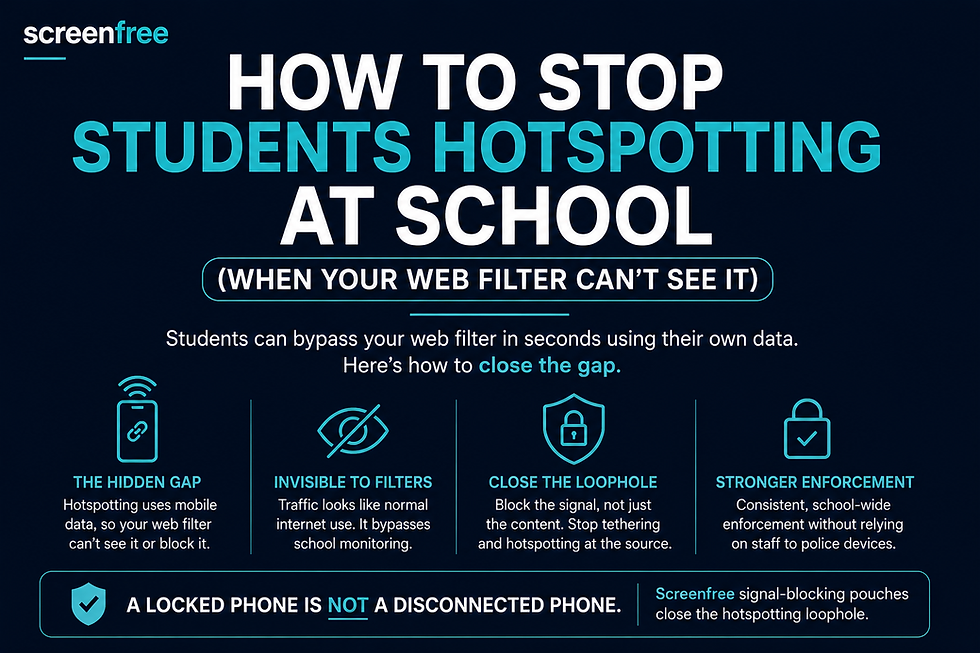
A lock-only pouch stops a student holding their phone. It does not stop the phone. A locked phone still has full connectivity, which means it can still act as a mobile hotspot for a laptop or tablet, still tether, still push notifications, still mirror to another screen and still run in a bag all day. Any school that has dealt with hotspotting knows the loophole closes about as fast as students find it.
Signal blocking is the functional answer to that specific problem. Sealed correctly, the phone is designed to be unreachable and unable to reach out, so there is nothing to tether to.
If hotspotting or tethering is not an issue at your school, a standard lockable pouch is a genuine and cheaper option. Plenty of schools are fine with one. The point is to know which problem you are solving before you buy, rather than discovering the gap a term after rollout.
What to ask a supplier
Two questions will tell you most of what you need to know.
First: is the pouch shielded, or only lockable? Ask directly. A surprising number of products described as signal-blocking are not.
Second: can I test it against a live hotspot? Put a phone in the pouch, seal the flap, and try to connect a laptop to it. This takes about a minute and settles the question completely. Any supplier confident in the product will encourage you to try it.
Emergency access
Schools ask about this early, and rightly. With a pouch, the phone stays in the student's possession the entire time. It is not collected, not stored in a tub and not somewhere else in the building. If a phone genuinely needs to be reached, the pouch is unlocked at a station and the phone is available immediately. This is a different situation to a jammer, which removes service from an area whether anyone needs it or not.
This article is general information about Australian radiocommunications rules and is not legal advice. For the current rules on prohibited devices, see the ACMA's guidance on jamming equipment.
screenfree supplies lockable and signal-blocking phone pouches to schools across Australia, New Zealand, Singapore, Malaysia and the UAE. Samples are available for schools evaluating options.

Comments